
Ceramics 1
Ceramics 1
Unity-Principle of Design
Unity-Principle of Design
Unity-Principle of Design
Unity-Principle of Design
Unity-Principle of Design
Unity-Principle of Design


Line- Element of Art
Line- Element of Art
Classwork & assignments
Presentation slideshow
Presentation slideshow
Classwork & assignments
Classwork & assignments
Lines are everywhere. You can see lines in the grain of a piece of wood or in the cracks on a sidewalk.
In art, Line is an element of art that is the path of a moving point through space.
Lines are used to:
-
Create boundaries between shapes
-
Create boundaries between colors, textures or values
-
Lead the eye from one space to another
-
Create textures
-
Suggest emotional qualities
Lines are everywhere. You can see lines in the grain of a piece of wood or in the cracks on a sidewalk.
In art, Line is an element of art that is the path of a moving point through space.
Lines are used to:
-
Create boundaries between shapes
-
Create boundaries between colors, textures or values
-
Lead the eye from one space to another
-
Create textures
-
Suggest emotional qualities


Classwork & assignments
Grid drawing is a very old technique of transferring images (from sketches to a full size canvas or fresco, etc...)
Always make sure that the number of squares on the original picture and your working area are exactly the same (even if the size of the squares are bigger on the paper). This is because no matter how many times bigger (or smaller) you make the drawing, the proportions and dimensions can only stay the same if the number of boxes (squares) matches exactly.
Make sure you follow all steps below.
2.3.2 The Van Eycks and Rogier van der Weyden

Neoclassicism and Romanticism
It was the end of the 18th century and the world was changing. Revolution was breaking out around the globe. First in America, then in France and Haiti, people were rejecting old systems of government in favor of democracy.
These new political forms required new forms of expression. Inspired by the roots of their democratic ideals, the revolutionaries turned to ancient Greece and Rome.
This Neoclassical art sought to demonstrate the nobility and virtue of the revolutionary struggle, and the dignity of the working men and women who made up these new nations.
The Realities of Romanticism
Still, the battles they fought were not pretty. Reacting against the Neoclassical focus on the virtue of the revolution, the Romantics created works that appealed to emotions rather than the mind. They sought beauty in nature, but they also wanted to show the violent realities of war.
These two movements were both responses to the huge political and historical shifts of the time, and came to replace earlier artistic movements that could no longer express this changing world.
Complete the questions on your study guide as you work through this activity. Reviewing your notes before quizzes and tests will help you succeed. You'll be able to check your answers once you've completed the study activity.

Tennis Court Oath, ca. 1791, by French Neoclassical painter Jacques-Louis David. The image depicts an important event in the history of the French Revolution, but the painting was never finished because of the violent political climate of the time.

In this work titled The Genius of France Between Liberty and Death, painted in 1795 during the French Revolution, Jean-Baptiste Regnault uses the Neoclassical style to suggest that France was struggling in a battle between freedom and death, depicted here using ancient Greek figures.
Neoclassicism
In the late 1700s in Europe and the Americas — especially in France and the United States — citizens were inspired to rise up and overthrow old forms of government in favor of democracy.
This new political order needed new symbols, images, and art to reflect the character of the times.
Inspired by the roots of democracy, artists turned to the art of ancient Greece and the sculpture of ancient Rome, and Neoclassicism was born.
Neoclassicist artists rejected the fancy, upper-class Rococo style of the 18th century that relied on elaborate texture and symbolism.
Instead, the old and familiar Classical sculptures of ancient Greek art seemed calm, simple, and most important, full of virtue.
In Neoclassicism, the common man was a proud, pure, and noble figure much like the heroes of Ancient Greece, and very unlike the upper-class nobility that defined the art and politics of the previous century.
Everyday Heroes
Neoclassicism focused on modern-day public figures as heroic individuals with high moral character. Artworks emphasized the virtue of the men and women who made up the new democratic state.
What else set these works apart from the Rococo style that came before it?
-
Strong, clearly defined lines
-
Myths and figures from Greek and Roman history
-
Focus on the everyday lives of lower- and middle-class people
In 20 words or fewer, why might these artists have chosen to compare lower-class citizens to ancient Greek heroes?
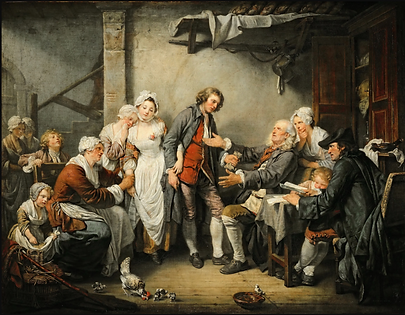
The Village Bride, ca. 1760, by French Neoclassical painter Jean-Baptiste Greuze.
Live Like Common People
Look at the painting. What do you notice? What kinds of figures does it represent, and how are they represented?
While this example of Neoclassicism may not seem all that unique at first, Jean-Baptiste Greuze's 1760 painting The Village Bride was praised at the time for its positive depiction of lower-class life.
Here was a painter who was not making fun of the lower classes or showing them as dirty and immoral.
What Do You See?
-
Which woman is the bride referred to in the title of the piece? How can you tell? How does she appear?
-
Where does this scene take place?
-
How do you know these people are of the lower class? What do you notice about their clothes?
-
Did you notice the chickens on the floor? What about the children in the room? What does this tell you about the lives of these people?
Greuze portrayed an angelic-looking bride. She represents the view of important revolutionary thinkers such as Jean-Jacques Rousseau, who believed the poor were full of virtue. Greuze's works clearly suggest the high morality and nobility of common people.

Portrait of the Copley Family, ca. 1776, by American Neoclassical painter John Singleton Copley.
A Revolutionary Spirit
In the 19th century, virtue sold paintings and brought them praise, particularly in the recently independent United States.
American painter John Singleton Copley captured the essence of modern heroism in his historical paintings. His portraits of leading colonial figures create a sense of their highly moral and virtuous characters.
In the United States, Neoclassicist artists were less concerned with the lower classes than with showing the morality of its newly founded government and leaders.
In his Portrait of the Copley Family completed in 1776 — the year of American independence — Copley depicts his own family in a classic and noble pose.
All in the Family
This is no ordinary family portrait. In Portrait of the Copley Family, John Singleton Copley was sending a variety of specific messages to his viewers.
What do you think he was trying to convey?
1) Which figure is the center of attention in the painting? What makes you think so? To see the art in greater detail, click the icon to the right.
2) Who do you think is positioned outside the focus of the painting? Why is that important?
3) What might the painter be trying to tell us about family life in 18th-century America?
The Death of Socrates, ca. 1787, by French Neoclassical painter Jacques-Louis David.
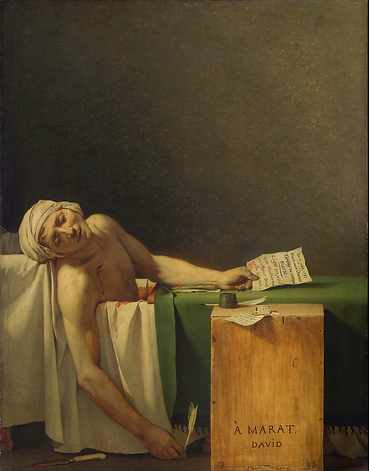
The Death of Marat, ca. 1793, by French Neoclassical painter Jacques-Louis David. Notice the peaceful, religious quality of the subject's pose. David is calling upon a long tradition of religious and classical painting.
A Revolutionary Life
The education and personal history of French painter Jacques-Louis David made him the ideal Neoclassical artist.
From 1775 to 1781, David lived and worked in Rome, studying Classical art treasures and becoming the official painter both for the revolutionary cause in France and for Napoleon Bonaparte, who would later become the ruler of France after the French Revolution.
David's participation in the French Revolution gave him a direct tie to the democratic values of Neoclassicism.
Neoclassicists in France consciously avoided the portraits of royals, aristocrats, and popes who were the main subjects for past generations of artists. Instead, the leaders and ideals of France's new republic were often tied artistically to great leaders of the past.
David's Death of Socrates makes an obvious nod to the Greek era. Socrates was a famous philosopher and important historical figure from ancient Greece. He dedicated his life to changing the old form of government and was ultimately tried and put to death for it.
Blood Bath
Jacques-Louis David seized the opportunity to advance the ideals of the French Revolution in his famous painting The Death of Marat.
It shows one of the key leaders of the French Revolution who was murdered in his bathtub. What do you notice about the image? How is his death depicted? To compare this to earlier paintings of Jesus Christ, click the In focus icon to the right.In focus
The headdress and draped bath sheet, along with Marat's body and position, are all very reminiscent of Classical art. But what else does it remind you of?
volume_up
Jesus of the Revolution
David deliberately painted Marat as a Christ figure of the revolutionary cause for which he died.
Doesn't Marat remind you of Jesus Christ in paintings like the Pietà by Rogier van der Weyden and the Isenheim Altarpiece by Matthias Grünewald?
Although the viewers at the time could have easily connected Marat with famous depictions of Jesus on the cross, the sacred quality of the writer's death is not associated with the Catholic Church.
It was David's goal to transfer those associations from the church to the French Revolution.


Check Your Understanding
Romanticism
The world was turning over on itself. Neoclassicism provided the new art necessary for a new society. Rationality and virtue inspired these painters. Their art in turn inspired the people to continue fighting for heroic causes. But the revolution was not always noble or beautiful.
Between June 1793 and July 1794, as many as 40,000 people were executed by the French Revolution government, a period known as "The Reign of Terror." This bloody history took its toll on the revolutionary spirit of many.
Having lost faith in human rationality, many artists, writers, and philosophers turned away from the cold rationality of the early revolutionary leaders.
The Art of Romance
Romanticism appeared in the early 19th century as a response to the violence and cruelty of war. The Romantics were a loosely tied together group of artists and writers who placed greater importance on the passion of the heart than on the mind's ability to reason.
Rather than paint works that idealized a detached, dignified simplicity as the Neoclassicists did, Romantics created works that appealed to human emotion.
By appealing to sentiment and passion, the Romantics hoped to provoke the public to take action against social injustice seen during and after the bloody revolution.

The Colossus, ca. 1808, was once attributed to Spanish painter Francisco de Goya. It is now believed to have been painted by Asensio Juliá, Goya's friend and associate. Many have interpreted the giant to represent the impending doom and violence of war.

The Third of May, 1808, ca. 1814, by Spanish Romantic painter Francisco de Goya.
Emotional Attachment
After the French Revolution, Napoleon Bonaparte rose to power. He crowned himself emperor of France in 1804 and maintained power until 1815. During this time, Napoleon engaged in many violent conflicts with other European powers.
The violence that was taking place all over Europe during Napoleon's reign was a popular theme of Romanticism. These artists' images could create extreme feelings of despair or patriotism, depending on how they depicted a given subject.
The Spanish painter Francisco de Goya y Lucientes, commonly referred to simply as Goya, was a master at creating massive, vibrant, and often bloody artworks. Terror, ugliness, war, and death found places in his most powerful paintings.
As official painter to King Charles IV of Spain, Goya produced the predictable royal portraits in his early career. But, by the time of Napoleon's invasion of Spain in 1808, Goya's work had become devoted to the horrors of war.
In perhaps his most famous work, The Third of May, 1808, Goya captures the emotional terror of the Spanish who stood before the invading French firing squads.
He also wanted to honor Spain's resistance to Napoleon's armies.
The Face of Horror
The spirit of Romanticism calls for bold, dramatic artworks. How does Goya create drama in The Third of May, 1808?
1) How does Goya depict the horror of war in this painting?
2) What is the focus of the image? Who is your eye drawn to when you first glance at the painting?
3) Who or what is hidden from view? Why do you think this may be?
On the Web...
-
Goya created a lot of dark, disturbing art, largely encompassed in what is known as "the Black Paintings". Click here to see what is perhaps his most gruesome work, Saturn Devouring his Son. Read the explanation of the painting and its comparison to another work on the same subject by Peter Paul Rubens.
-
Not all of Goya's works were grotesque. Click here to explore a full collection of his art.
Beautiful Tragedy
A contemporary of Goya, Eugène Delacroix, painted massive, bloody, war-filled canvases in France.
One of his most famous paintings, The Massacre at Chios, was inspired by a news story about the Greek war against the Turks. It encouraged many daring young men in western Europe to head off to join the Greek war effort.
Delacroix sympathized with the Greeks, but was charmed by the Middle Eastern subjects of the story. This fascination with the culture of the Middle East and "Oriental" styles was a common theme for many Romantics, and it inspired many paintings.
Visions of the East
In The Massacre at Chios, the viewer sees the power of the military and the horror and despair it inflicts. The figures in the foreground have been completely overtaken by the unsympathetic horseman to the right. There is a sense of hopelessness that inspires sympathy for the victims, and in the background lies the ruined landscape that the soldiers have left behind.
But even if the figures are tragic, they are still beautiful and romantic. Dressed in colorful fabrics, they display the exotic charm and wild spirit that the Romantics prized. This contrast between the beauty of the subjects and the horror of the scene creates the strong emotions that define Romanticism.

The Massacre at Chios, ca. 1824, by French Romantic painter Eugène Delacroix.

Living Landscapes
Romanticism was not limited to historical or human subjects. Romantic artists also captured the beauty and emotion of nature through landscape painting.
Unlike landscapes of the past, Romantic landscapes took on a sense of emotion and movement. No longer quiet and peaceful visions of the natural world, the Romantic countryside and oceans were pulsating environments capable of transforming the viewer's soul.
Landscapes Changing Slowly Over Time
Do you remember the famous painting The Harvesters by Pieter Bruegel the Elder? Compare that piece with one from German Romantic landscape painter Caspar David Friedrich, Man and Woman Contemplating the Moon.
Compare the Landscapes
1)Bruegel's The Harvesters appears on top, while Friedrich's Man and Woman Contemplating the Moon appears below. What is the most striking difference between the two paintings?
2) How is nature depicted in each piece?
3) What is the main focus of each piece?
William Blake
It was a Romantic poet, William Blake, whose extreme style captured the soul of Romanticism. Look at his painting The Body of Abel Found by Adam and Eve. What do you think of it?
In 20 words or fewer, what do you think of when you look at this painting?

ARTIST William Blake 1757–1827 MEDIUM Ink, tempera and gold on mahogany

The Ancient of Days, ca. 1794, by English poet and painter William Blake.
Check Your Understanding
Radiant colors, suspended angels, penetrating eyes, and intricate symbols were the prevailing motifs used to represent the supernatural world throughout the early Middle Ages.
But the rules were changing. The heavenly figures of medieval art would soon come off their golden thrones and be put back into an earthly setting.
A Romantic Madman
William Blake was not the most skillful artist, and he spent most of his career illustrating biblical passages and his own poems.
Blake distrusted the attitudes of the academics and artists of his time, and completely refused to paint from life. Instead, he created images based purely on his imagination.
The Ancient of Days shows a Christian god unlike any that had been seen before. What do you notice in this depiction of God creating the world? What images does it remind you of? How might it be different from other representations of the Christian God?
The radiating light, the humanistic view of God the Father fashioning the world, and the movement of hair in otherwise stillness lend the painting a mystical quality. Many at the time thought Blake was mad. Today, he is generally considered a visionary who was way ahead of his time.

In Review
Before moving on, review what you have learned in the study. Go over the notes you wrote on the study sheet. Ask your teacher any questions you might have.
If you have not filled out your study sheet, do it now before moving on to the next activity.
Study sheets are a very useful tool to help you study for quizzes and tests.
What Did You Learn?
-
John Singleton Copley pioneered Neoclassicism, a school that rejected Rococo extravagance and looked toward Classical art that was simple and virtuous.
-
Jacques-Louis David directly connected Neoclassicism to Classical Greek art in The Death of Socrates, in which he depicted the exemplary life of Socrates in the face of a corrupt government.
-
Romanticism was another movement that emerged in response to the revolutions going on around the world, especially in France and the United States.
-
More than Neoclassicism, Romanticism sought to depict the general loss of faith in the revolutionary leaders.
-
The Romantic style was bold and dramatic in order to evoke passion and emotion.
-
By appealing to sentiment and passion, Romantic art aimed to inspire people to take action against social injustice.
-
Goya's The Third of May, 1808 used vibrant color to communicate the terror and fear of an actual event to viewers.
Take this opportunity to check your work.